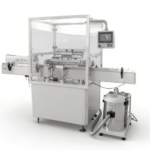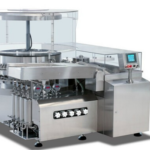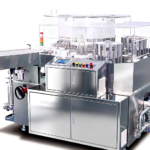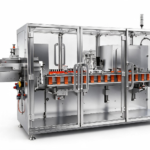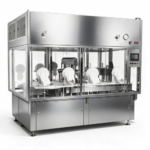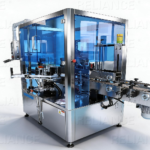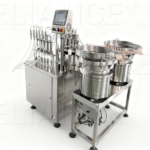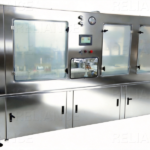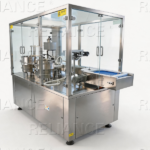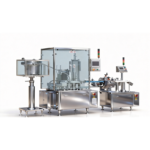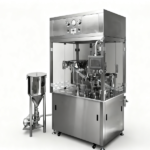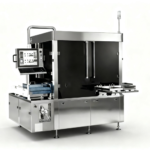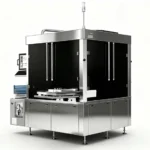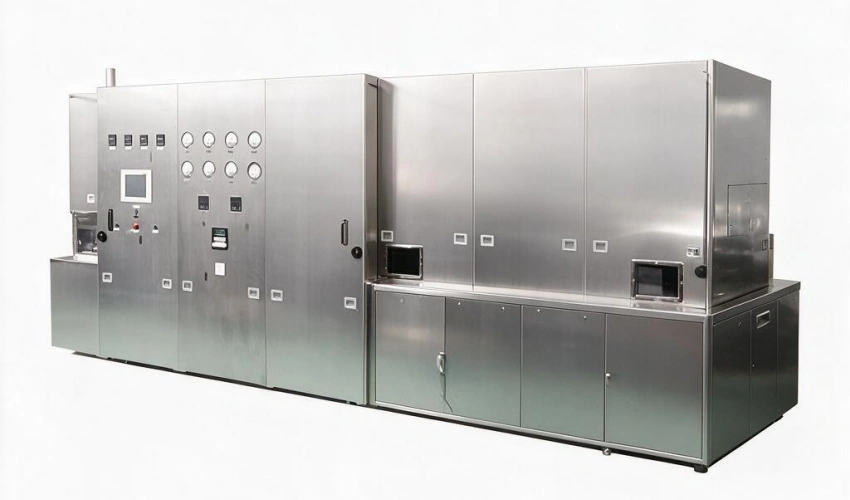
Glass Vials Depyrogenation Tunnel
Request a Quote
Enter the quantity you need and add to your quote list for pricing inquiries.
DESCRIPTION
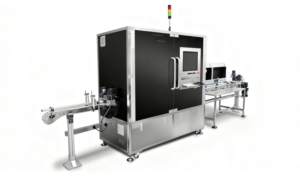
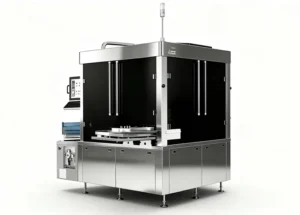
The laminar flow dehydrogenating tunnels are the result of years of research and experience in the field of serialization and degeneration.The tunnels are suitable for being included in continuous production lines, which require a sterilization and degeneration process by dry heat for glass containers such as vials, ampoule, etc.
The heating of containers is made by using hot air, treated with pre-flters and absolute filters HEPA or ULPA, which protect the container during the complete preheating sterilizing dehydrogenating and cooling process; along the entire length of the tunnel the air quality is lO5 as per lSO 14644.
The machine designed and built according to cGMP standards, uses solution sat the forefront of technology and therefore is able to guarantee the repeatability and the absolute control of the process, and the easy use.
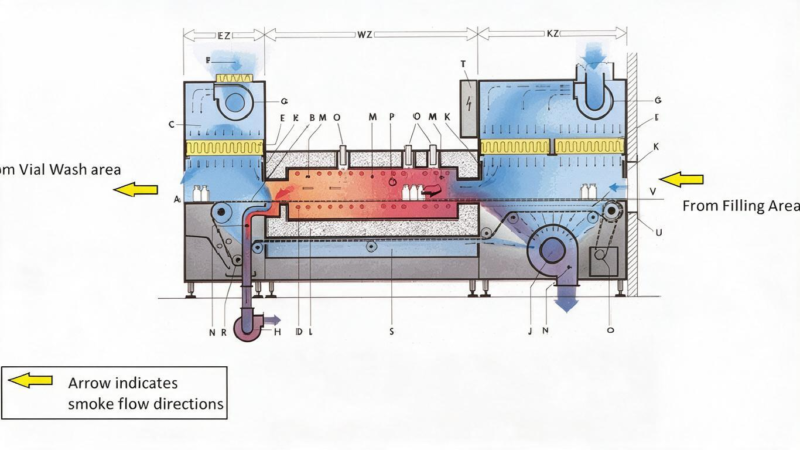
Working Principle:
This series of Pharma Glass Vials Depyrogeneration models meet the requirements of yy 0217.3-2005 pharmaceutical industry standard, and meet the GMP specifications. The heat distribution in the tunnel is uniform, and the temperature difference in the sterilization section is ± 5 ℃. In the hot air circulation sterilization tunnel oven, high efficiency filters are installed in the bottle inlet section, heating and sterilization section and cooling section, so that the medicine bottle is sent out of the oven through stainless steel mesh belt from the bottle inlet section through the heating and sterilization section to the cooling section. During the process, the bottle mouth is always under 100 level protection to ensure that the medicine bottle is not polluted.
SPECIFICATION
| Main Specifications | RHT-1 | RHT-2 | RHT-3 | RHT-4 |
| Capacity:(Vial/min) | 100~800 | |||
| Application | 2ml、5ml、7ml、10ml、15ml Kinds of mould vial and tube vial. | |||
| Total Power for heating:(kw) | 54 | 66 | 80 | 40 |
| Electromagnetic Speed Controlling motor: |
0.75~1.5KW | |||
| Linear Velocity of Stainless steel conveyer (m/min) |
0.3~0.37 | 0.3~0.37 | 0.2~0.27 | 0.3~0.32 |
| Sterilization Temperature | 350℃+30℃
-10℃ |
|||
| Duration of vial in sterilizing zone is more than 5 minutes | ||||
| Temperature of vial at the Outlet of the tunnel | ≤40℃ | |||
| Dimension L×W×H mm | 5200~12100×1000~1600×1700 | |||
| Height from ground to glass line 930mm | ||||
| Weight appr (kg) | 2500~5000 | |||
FAQ
1.What is a pharmaceutical depyrogenation heating tunnel?
A pharmaceutical depyrogenation heating tunnel is a continuous dry-heat processing system designed to sterilize and reduce endotoxin levels on glass containers, such as pharmaceutical vials and ampoules. It typically includes preheating, high-temperature treatment and cooling zones, allowing washed containers to move directly toward an aseptic filling line.
2. What is the difference between sterilization and depyrogenation?
Sterilization is intended to eliminate viable microorganisms, while depyrogenation aims to inactivate or remove pyrogens, particularly bacterial endotoxins. A properly validated dry-heat process for glass containers may achieve both objectives. The required performance must be established through appropriate process validation.
3. What endotoxin reduction should a depyrogenation tunnel achieve?
A commonly applied acceptance target is at least a 3-log10 reduction in endotoxin concentration, equivalent to 99.9% reduction. Validation should use representative containers challenged with endotoxin and include suitable recovery controls, quantitative testing and justified worst-case processing conditions.
4. What operating temperature is required for a vial depyrogenation tunnel?
The required temperature depends on the vial material, container mass, conveyor speed, heating profile and validated process. The supplier should propose a suitable temperature range and demonstrate performance through heat-distribution, heat-penetration and endotoxin-challenge studies. A single temperature setting cannot establish process effectiveness.
5. How is the residence time in the heating zone determined?
Residence time depends on the effective heating-zone length and conveyor belt speed. However, geometric residence time is not the same as the time the vial itself spends at the target temperature. Heat-penetration studies are required to establish the actual vial temperature profile and effective thermal exposure.
FEATURE
1. The design of equipment’s structure is using the materials of high temperature resistance, and adopts DOP (Di-Octyl Phthalate) or PAO (Poly Alfa Ollefin) test (99.97%) to the following places: bottle inlet, drying sterilization area and sterile dust-free cooling area. Therefore, when the temperature and time reach to a certain status, and the materials of bottles and appliances are all having the features of high temperature resistance and unbreakable, the bacteria of products can be completed sterilized and depyrogenated.
2. The 0.3μm high efficiency & high temperature resistance HEPA filter keeps the cleanliness of tunnel chamber within Class 100 to prevent product pollution, and adopts SCR control for the electrical system to make the curve of current output displaying as linear status, and the temperature can be distributed averagely.
When the equipment is tested under no-load condition and normal regulation, the heat distribution at each internal point is within ± 10°C when sterilizing. Calculating the lowest temperature of FH or FP value when the temperature is set at 250°C. Calculating the required sterile time depends on various temperature, normally when the lowest temperature reaches 250°C and continuing at least 30 minutes, then the heat can be depyrogenated, however, most users are using the way of overkill to depyrogenate.
3. During sterilization, the temperature of heat distribution at each point inside is within ± 10°C. When the temperature is set at 250°C, the FH or FP value of the lowest point temperature is usually calculated, and the required sterilization time is calculated according to different temperatures. Generally, when the lowest point temperature reaches 250°C, and lasts at least 30 minutes. Remove the heat source, but most users use the OVERKILL method to remove the heat source.
DOCUMENTATION
-The complete procedure of the equipment: bottle feeding -> preheating -> sterilizing -> cooling and automatic rolling out the bottles.
-PLC control, touch screen interface, easy to operate.
-The control system uses SCR module being coordinated with that of temperature controller PID auto tuning and allows of current output curves appearing linear status to make the chamber temperature heat distribution more uniform. Under a normal regulation, the heat distribution is in the acceptance range of within ± 5℃ at a test of running free.
Functional specification (FS)
Design specification (DS)
Kualifikasi Pemasangan (IQ)
Kualifikasi Operasional (OQ)
Operation manual
Maintenance manual
Material certification
Control loop drawing
Instrument list
Electrical schematic
P & ID drawing
Machine structure drawing